Sensing and response, knitted into the cabin
What we do for automotive OEMs
The interior is where a car is judged, and the hardest place to add anything. Every new function means more wiring, more weight, more time on the line.
We put the function into the surface instead — the seat, the wheel, the trim. And we do the whole job: materials, sensing, electronics, testing, production.

The four cabin systems
Four systems, scoped on their own or delivered as one cabin. Full specifications open below.
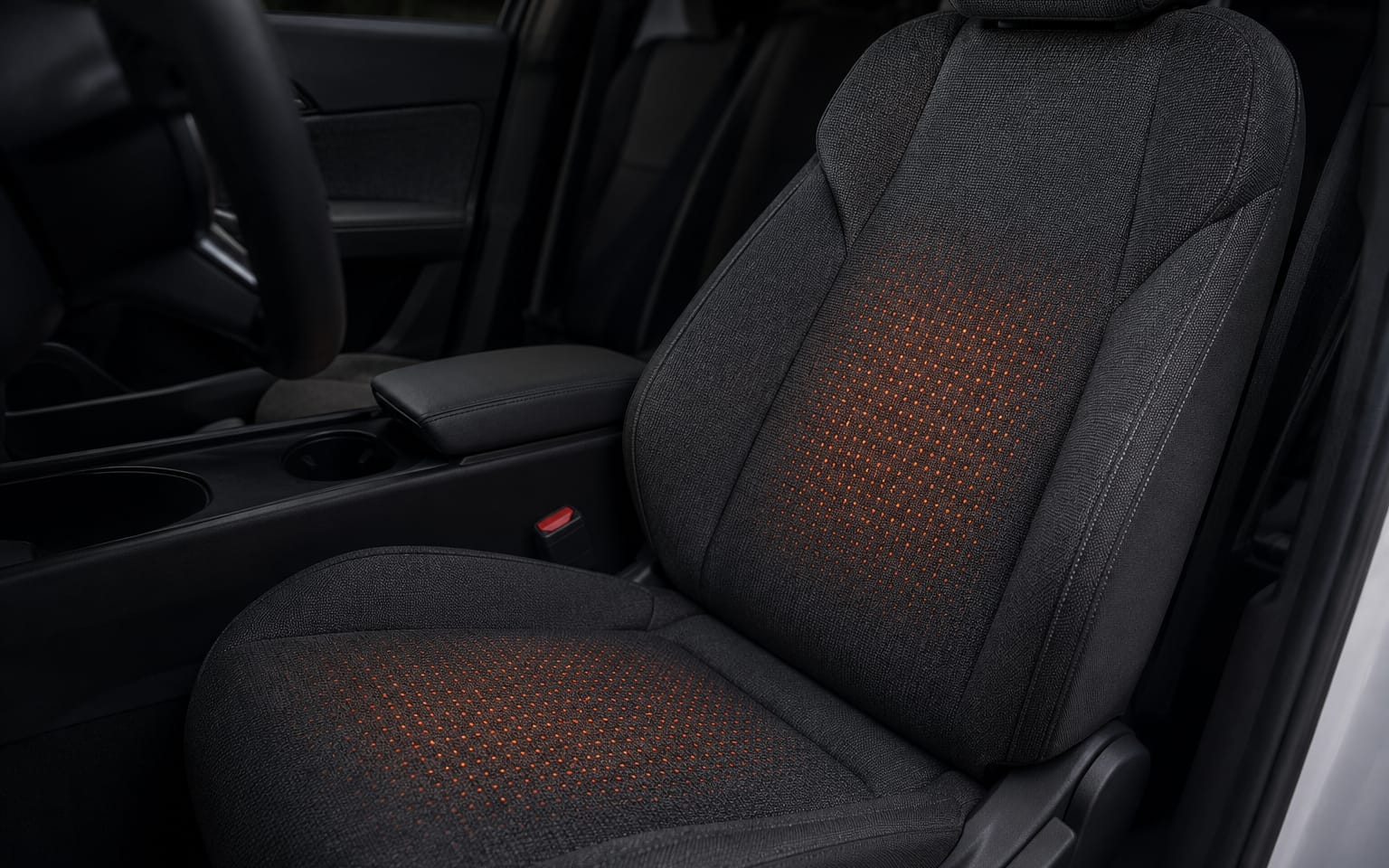
Heated surfaces
Zoned panels warm contact points instead of cabin air — an active thermal barrier that helps preserve EV range.
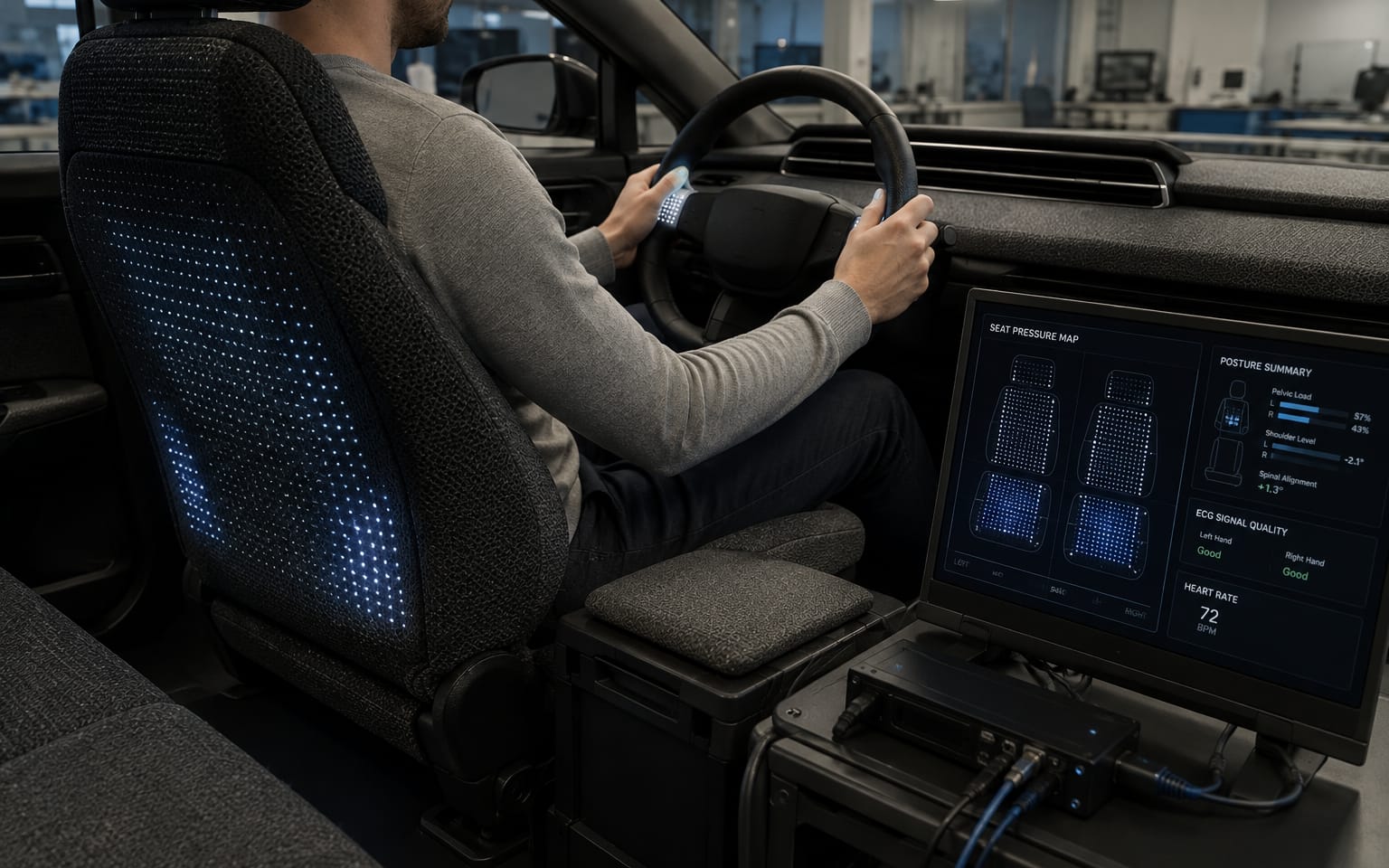
A seat and wheel that read the occupant
225-cell pressure panels resolve occupancy, position, and posture. Steering-wheel electrodes capture ECG — no wearable, no driver action.
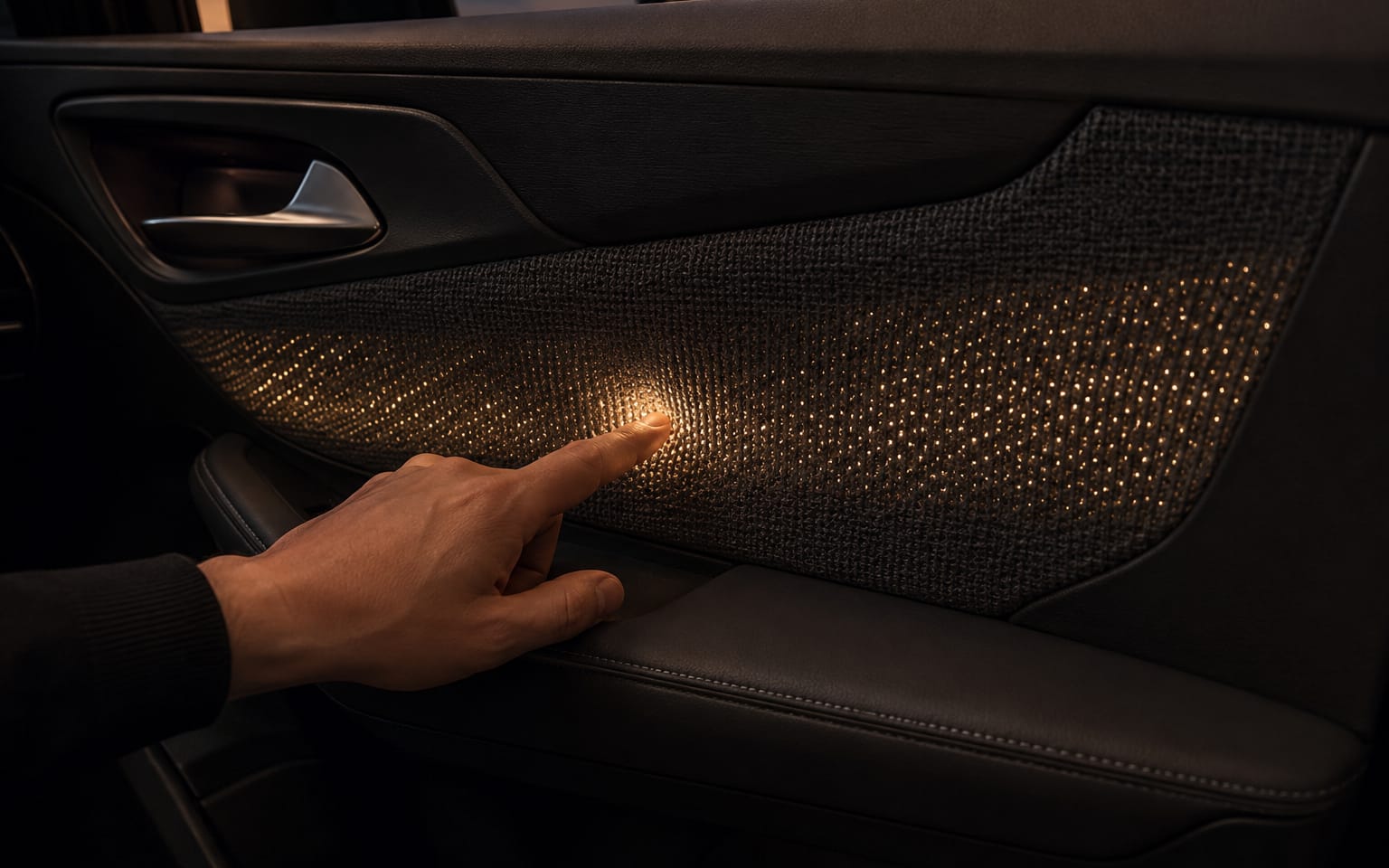
Knitted light and touch
RGBW light and tactile controls live in the surface itself — headliner, dash, door, armrest — replacing discrete buttons and light guides.
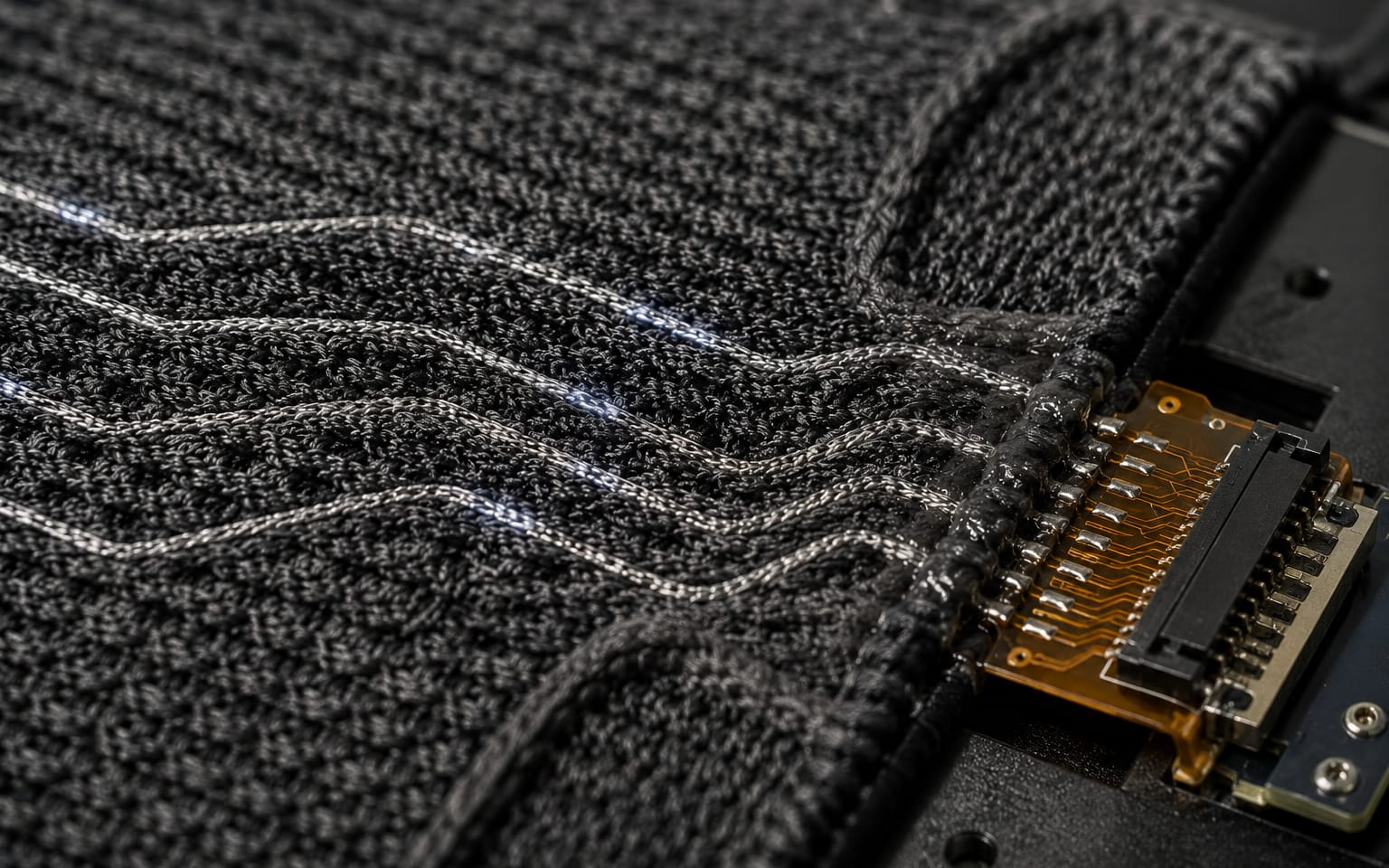
Textile wiring
Conductive yarn routes power and data through the trim itself, replacing copper harness weight and the assembly steps built around it.


Proven in a running vehicle
The connected cabin — steering-wheel ECG and the 225-cell pressure-sensing seat — was built into Canada's all-Canadian concept SUV (APMA) and shown publicly at CES 2023.
- Occupant detection & classification
- Seat-matrix pressure sensing resolves occupancy, position, and posture — the input layer for airbag logic, comfort automation, and fleet telematics.
- Textile-to-Electronics (T2E)
- Proprietary bonding and interface processes connect knitted sensing and actuation to automotive electronics, specified per program with BLE or hard-wired options.
- Passive physiological sensing
- Heart rate, respiration, and muscle fatigue, read passively from the seat and belt — no wearable required.
The system in detail
Every figure is carried from the engineering record. Architectural capabilities are described as what the system supports.
Cabin heat panels
Traditional HVAC systems waste energy heating the entire volume of empty cabin air. Myant's active heat panels deliver targeted, efficient warmth directly to the passenger's body contact zones. Designed with top and bottom thermal zones, these panels function as active thermal insulators to reduce overall heat loss through the cabin walls.
- Zonal Heating Layout
- Separate top and bottom thermal heating zones, each measuring 25×30 cm and operating on an independent 2-channel system.
- Precision Temperature Control
- Engineered to deliver two optimized thermal performance modes based on voltage configurations: Standard Comfort Mode and Rapid Heat Mode.
Pressure-sensing seat panels
Sitting for long commutes causes muscle fatigue and poor circulation. The seat covers integrate textile pressure panels that continuously map the driver's contact surface. From the pressure distribution, the vehicle's onboard systems can detect fatigue, poor posture, or tension — and prompt micro-adjustments or adaptive support.
- High-Density Grid Array
- Equipped with top and bottom seat cover pressure panels.
- Resolution
- Each panel contains a high-resolution grid of 225 independent pressure-sensing cells arranged in a 15×15 matrix.
- Sensing Surface Area
- 50×46 cm per panel — edge-to-edge coverage across both the seat cushion and backrest.
Biosensing in the wheel and seat belt
Conductive sensing yarns embedded in the steering wheel and seat belt let the Connected Cabin track physiological signals continuously and passively — enabling biometric driver identification and fatigue or stress detection without requiring the driver to wear a smartwatch or monitor.
- Electrocardiography (ECG)
- Steering wheel-integrated electrodes capture QRS heart signals to measure real-time heart rate and verify driver identity through unique cardiac pattern classification.
- Respiration Monitoring
- Integrated pressure sensors within the seat belt fabric track breathing rates and cycle patterns.
- Expanded Health Diagnostics
- System architecture supports full passive monitoring of EEG for cognitive focus, EMG for physical tension, and EOG to detect drowsiness.
- Active Seat Belt Assistance
- Real-time breathing and posture data drives automatic, motor-driven micro-adjustments to seat-belt tension.
Knitted light panels
Myant's knitted light panels embed arrays of RGBW LEDs directly into the textile fibers of the ceiling, dashboard, and door panels. Utilizing Myant's textile computing to concentrate spotlights and specialized spacer fabrics to diffuse glow, the cabin's lighting adapts dynamically to alert the driver of road hazards, indicate vehicle status, or cultivate a calming cabin environment.
- Bottom Light Panel Matrix
- Top Light Panel Matrix
- Advanced Optical Comfort
- Each light panel is specialized to focus individual spotlights and structured with spacer mesh to distribute light smoothly across the fabric.
- Dynamic Visual Modes
- Switches across operational profiles: OFF Mode, Blue Laser, Green Laser, and dual Blue + Green Lasers.
Tactile controls and surface display
- Integrated Tactile Interfaces
- Standard physical buttons are replaced with tactile textile sensors embedded directly into the fabric surface.
- Fibre Optic Dashboards
- Woven fibre optics display critical infotainment and vehicle diagnostics right across your upholstered interior surfaces.
- Fabric Wireless Charging
- Embroidered electromagnetic charging loops are integrated directly into armrests, allowing smartphones to charge wirelessly.
Textile wiring and 3D knitting
Traditional vehicles carry miles of heavy copper wire harnesses and complex, multi-layered metal and plastic interior shells. Myant replaces this weight with textile-based wiring and advanced carbon-fiber structural composites.
- Integrated Fabric Wiring
- Power/data knitted directly into fabric.
- Single-Step 3D Contouring
- Complex 3-D shaping in a single run.
- Reinforced Substrates
- Robust carbon fiber materials integrated.
How an automotive program runs
Start with one panel or the whole interior. The scope changes; the sequence does not.
- 01
Define the panel and the boundary
Specification, integration boundary, and validation plan are fixed before any tooling — so the target agreed at kickoff is what the program is measured against.
- 02
Engineer and characterize
Material, sensor geometry, and electronics are developed together and tested in-house — durability, signal quality, and the T2E interface.
- 03
Move to production
Process engineering and pilot production run against manufacturing-readiness levels, with no hand-off to a separate supplier.
Bring us a panel or the whole cabin
Send a target specification or an interior concept. You get back the systems in play, the boundary to your electronics, and the route to a validated prototype.