The Invisible Clinic in your bedroom
What we build for sleep and bedding brands
Medical-grade sensing and response, knitted into the bed and the bedding — not strapped to the sleeper. We develop it with you, prove it against reference measurement, and carry it to production.

Two sleepers, two physiologies
One bed, one climate, two physiologies. A single-zone product is wrong for one of the sleepers every night — and they both bought it.

Sleeper A — sleep-onset insomnia
- Typically a cold sleeper, especially struggling with cold extremities.
- Struggles with Restless Leg Syndrome (RLS) and significant sleep fragmentation.
- Chronic fragmentation is linked to 4.1x higher relative odds of depression in younger cohorts.
Sleeper B — elevated OSA risk
- Typically a hot sleeper prone to night sweats and elevated temperatures.
- Habitually snores loudly (30-40% of adult men), disrupting partner sleep.
- Untreated Obstructive Sleep Apnea (OSA) leads to cardiometabolic strain and Excessive Daytime Sleepiness.
What the bed does while they sleep
Every intervention is a closed loop — read the body, decide, act on the environment, without waking anyone.
Dual-zone micro-climate
Each side runs its own temperature, 55°F to 115°F, driven by biometric feedback rather than a dial.
Snore mitigation
When snoring persists, the base raises that sleeper's head by roughly 12° — quietly enough that neither partner wakes.
Limb-movement tracking
EMG resolves high-frequency micro-tremors, separating ordinary tossing and turning from Restless Leg Syndrome and Periodic Limb Movements.
Vibroacoustic wind-down
Delta and Theta frequencies with continuous low-amplitude vibration, to bring down the hyperarousal behind sleep-onset insomnia.
What makes it feel like bedding
The sensing is the textile — knitted into the sheet, the cover and the base, not clipped onto them. That is what lets a medical-grade system still feel like bedding.
- 01Knitted sensing surfaceDry electrodes, pressure and stretch sensing knitted directly into the sheet and cover — washable, seamless, with nothing for a sleeper to wear or remember.Textile Computing™
- 02Pressure and presence mappingA full-surface pressure field resolves posture, movement and bed occupancy — no camera in the room, no device on the body.Pressure mapping
- 03Thermal actuationHeating and cooling constructions act by zone, driven from the same textile system that does the sensing.Thermal regulation
- 04Signal processing and stagingRaw physiology becomes sleep stages, events and trends — on our platform, or streamed into yours.The Platform
- 05Characterization and evidenceEvery construction is characterized in-house against reference measurement before it goes near a product line.Analytical Testing
Measured against polysomnography
- Sleep staging
- Greater than 90% equivalence to polysomnography, from models trained on more than 250 million nights of data.
- Thermal range
- The micro-climate operates from 55°F to 115°F, adjusted per zone from biometric feedback.
- Snore response
- Detected acoustically, corrected mechanically — not with an alarm.
Two reference systems, already built
Neither is a catalogue item. Each is a build that proves a different part of the stack — and each carries its specification below.
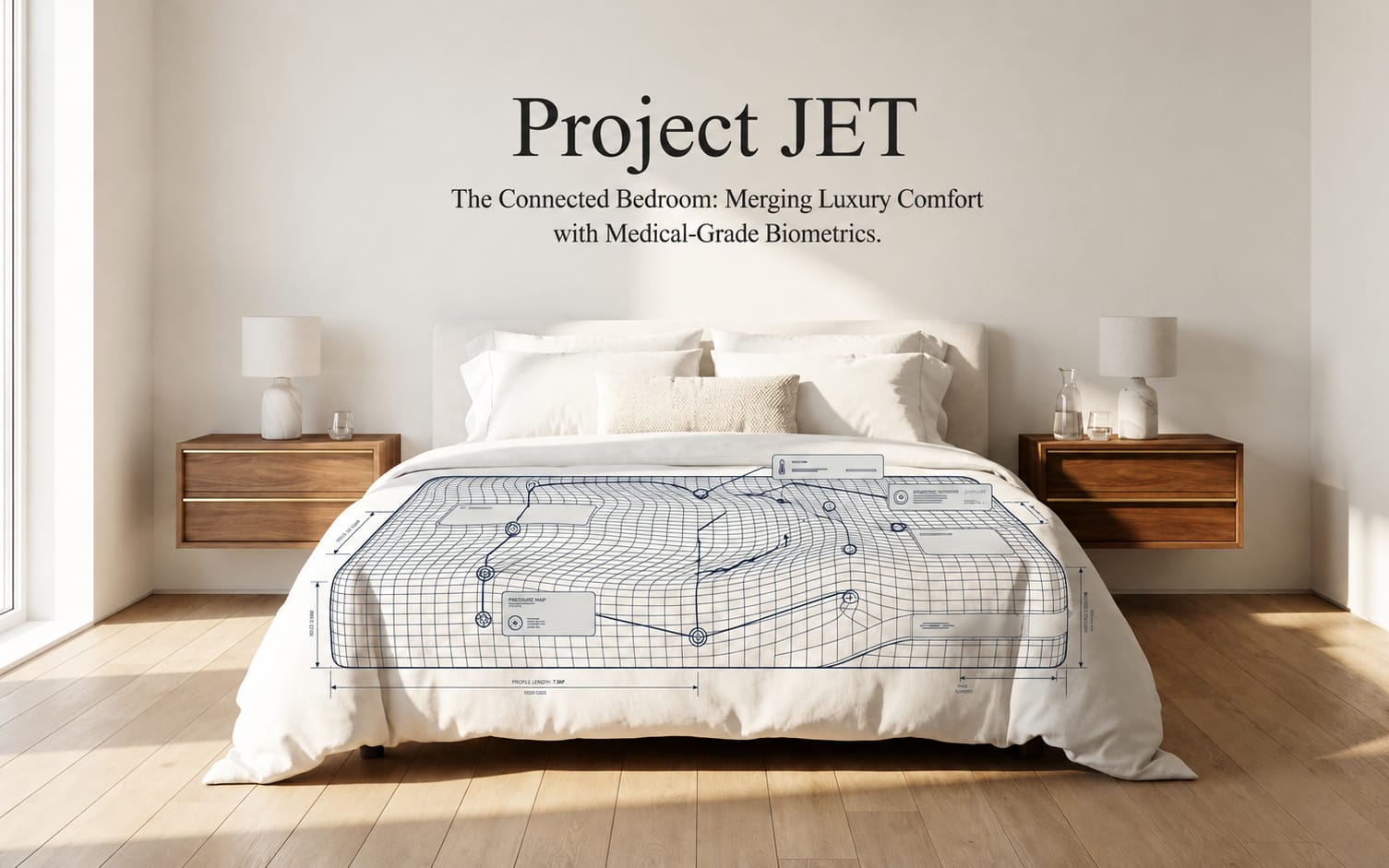 Consumer sleep
Project JET
Sensing, dual-zone climate and snore response built into the bed and bedding, responding to biometric signal in real time.
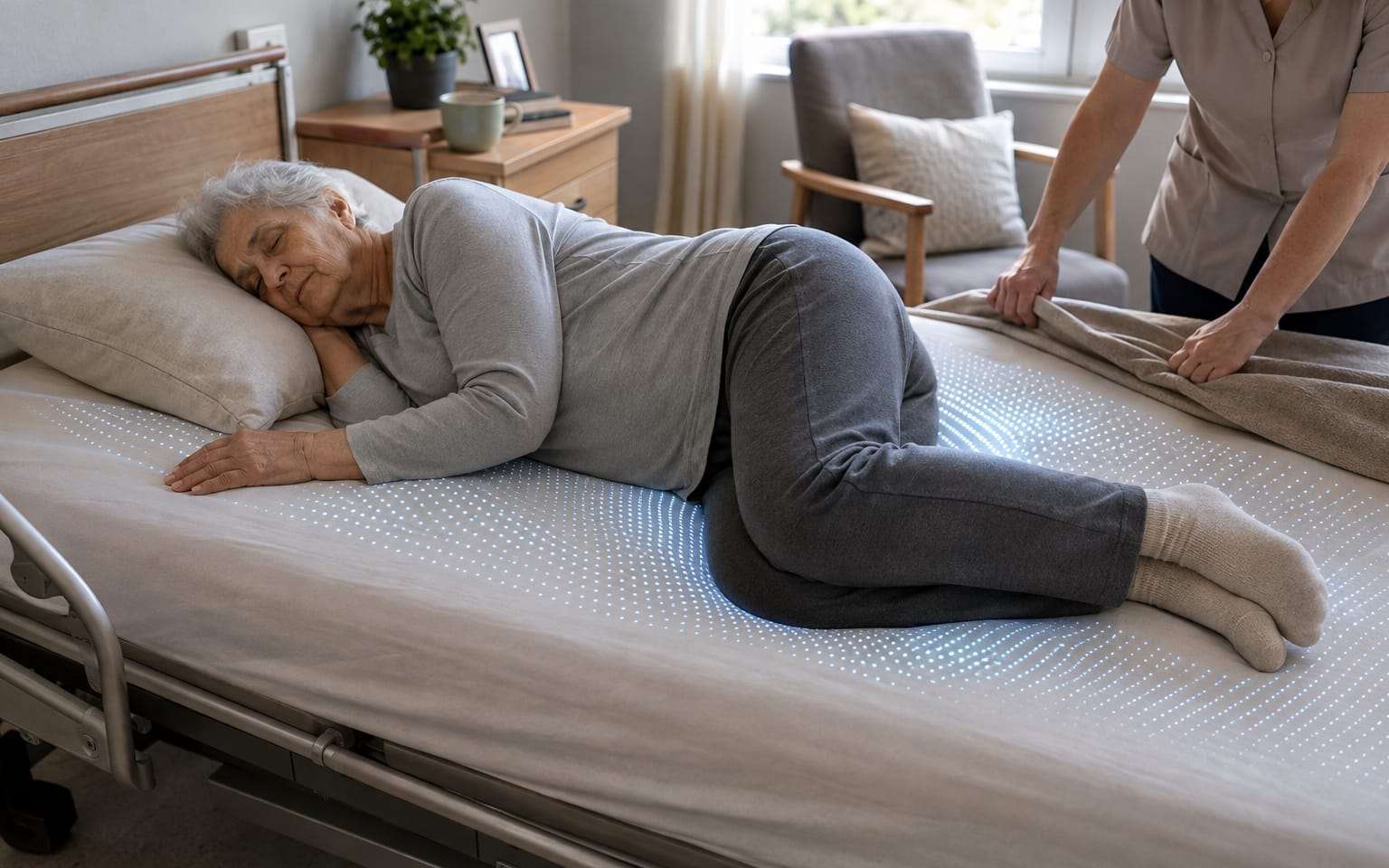 Care setting
The pressure-sensing bedsheet
A monitoring surface that turns a standard mattress into a sensing bed — nothing worn, nothing to remember.


Specifications and validation
Project JET — closed-loop interventions
The system responds to biometric signal in real time, adjusting the sleep environment automatically.
- Active Dual-Zone Micro-Climate
- Autonomously adjusts from 55°F to 115°F based on biometric feedback. Detects pre-sweat phases to engage evaporative cooling, or generates targeted warmth to counteract cold extremities and accelerate sleep onset.
- Snore mitigation
- Acoustic and vibration sensors identify sustained snoring frequencies. The smart base silently elevates the sleeper's head by approximately 12° without waking them, opening the airway and protecting the partner's sleep.
- Targeted Neurological Tracking
- EMG bands detect high-frequency micro-tremors. The system successfully differentiates normal tossing and turning from Restless Leg Syndrome (RLS) and Periodic Limb Movements (PLMS).
- Vibroacoustic Entrainment
- The base can deploy a “Wind Down” program emitting Delta (1-4Hz) and Theta (8-10Hz) wave frequencies alongside continuous low-amplitude vibration to actively reduce the hyperarousal state causing insomnia.
Bedsheet — internal validation
Distinct from the Project JET sleep system, the pressure-sensing bedsheet turns a standard mattress into a monitoring surface for care settings — no garment to wear, nothing for a resident to remember. In internal validation it detected motion at ~99% accuracy, classified posture at ~94%, resolved bed occupancy at ~99.6%, and tracked respiration with a median error under 2 breaths per minute.
- Repositioning support
- Movement and posture history gives care teams the record they need to time pressure-injury-prevention repositioning.
- Presence & respiration
- Bed occupancy and breathing trends surface overnight events without cameras or worn devices.
Figures are from internal validation of the bedsheet system — a product in development, not a released medical device.
Three ways a sleep program starts
Same stack, same discipline — a different starting point depending on what you already own.
Mattress and sleep-product brands
A product line that has to carry a health story, and cannot feel like a medical device.
What we configure · what you get
What MyantX configures- — Dual-zone thermal constructions built into cover, sheet and base
- — Sleep staging and event detection from textile sensing
- — Wash, durability and comfort qualification against your specification
Program outputs- — A sensing-and-response specification for the line
- — A validated prototype with characterization data
- — A pilot-production and cost pathway
Care operators and care-bed OEMs
A resident population you need overnight visibility on — without cameras, and without anything worn.
What we configure · what you get
What MyantX configures- — Full-surface pressure sensing that turns a standard mattress into a monitoring surface
- — Posture, movement and bed-occupancy classification
- — Respiration and presence trending for overnight events
Program outputs- — A monitoring-surface specification
- — Internal validation data for the sensing set
- — An integration path into your care platform
Sleep-health and digital therapeutics
A therapeutic or diagnostic model that needs continuous physiology from the home, not one night in a lab.
What we configure · what you get
What MyantX configures- — Sleep staging benchmarked against polysomnography
- — Closed-loop intervention — thermal, positional and vibroacoustic
- — Evidence planning scoped to your intended use
Program outputs- — A measurement and intervention specification
- — A characterized prototype with an evidence plan
- — A regulatory and manufacturing pathway
Bring us a bedding line or a sleep system
Send a product concept, a sleep system, or a care-facility requirement. We define what it senses, how it responds, and the evidence behind both.